Reflections on the motive power of gunfire
Pub. 2026 Apr 20RÉFLEXIONS
SUR LA
PUISSANCE MOTRICE
DU TIRS
Par S. CARNOT
Translated April 2026
[Editors note: [todo: how this treatise was found].
This manuscript is now the last piece of known writing by Carnot before his death in 1832. The most notable thing about this manuscript, from a historical physics perspective, is that Carnot seems to have developed a much more sophisticated and modern understanding of thermodynamics since his 1824 treatise. It's known that Carnot had moved pass his caloric theory by the time of his death. But it was not known until now that Carnot seems to have connected the idea of temperature with microscopic motion, and has some understanding of entropy as a one-way process!
On the other hand, his signature "clarity of thought" is gone. There is a confusion of ideas demonstrated here, relating temperature and pressure of gasses with "temperature" and "pressure" in the social sense. It shouldn't need to be said, but human societies don't obey the ideal gas law. Is this an honest attempt to understand the French Revolution via physical laws, or something else? Is this analogy how he came to think of temperature as microscopic motion? We will probably never know.
The idea of interpreting social movements through a physics lens wasn't unheard of in Carnot's day. For example, this manuscript quotes Lettres d'Un Habitant de Genève À Ses Contemporains, written by Henri Comte de Saint-Simon in 1803. Saint-Simon advocated for scientists to play a larger role in society and to create a theory of the social sciences the same was Newton did for the natural sciences. He uses words like "la force d'inertie" to describe social "inertia". There are parallels here with works by other students of Saint-Simon, like Auguste Comte. But honestly, trying to draw a line between these works feels reductionist. This manuscript is on a whole other level. I'm not aware of any contemporary work with remotely similar subject matter. [todo: find a better example]
The other striking thing to note is the writing style. His usual first-person, conversational, sans-culottes style is still present. The [todo]
]
Every one knows that gunpowder can produce motion. That it possesses vast motive-power for both shells and people no one can doubt, in these days when the story of the Revolution is everywhere so well known.
These thoughts are based on conversations with Dupin and Clapeyron discussing to what extent, if any, the actions of peoples can be put on solid philosophical foundations.
Myself and my contemporaries feel awe and envy of Newton. His calculus of bodies in motion was a great gift to all students of philosophy. Taking after his example, everyone now wants a calculus of fluids. Generals want a calculus of tactics. Father wants a calculus of money and economies. But these are too narrow, splitting up our lives into pieces that can be reasoned. No one seems to want a calculus of people in their entirety.
The National Assembly saw the spontaneous physical separation of republicans and royalists. What mechanism can cause this?
The manuscripts in their hands are a sieve, a sort of reverse osmosis, a one-way barrier for people and minds. It couldn't have been more effective if they had printed their enlightenment thoughts on cheesecloth. The delegates there understood this too, for they then wrote the Declaration of the Rights of Man: a sieve that, with the right pressure applied, could separate an entire nation.
[todo]
People move independently inside their group, but as a whole will flow down streets, will fit the shape of a building they are in. They will bunch closer and flow slower when calm, but will spread and run out when agitated. This reminds me of Newton, who wrote of Man's mind as alchemical mercury. Fitting as people in this way, expanding and contracting with temperature, act like a mercury thermometer, measuring their own temperature. Perhaps Newton is ahead of us still.
[todo]
Let me engage in a little suasoria. Gaius Pontius, meddix of Samnium, you've defeated the Romans at Caudine Forks.
Cornering them in the valley, containing them, that was good. A drop of oil in water will contain itself and not disperse, but that doesn't work with Romans and Samnites. You both contain Umbrian blood, and so so are at risk of diffusing in each other. If you want the Romans contained, and eventually removed in an irreversible way, you need an impermeable membrane. One preferably made of spears.
You can transport the Roman army, contained in their spear bubble, back across the Apennines. This translation requires 0 work, because the bubble doesn't change volume. Make sure to keep them separate!
Alternatively they can be killed. The front line of a phalanx battle is a shoving game. I approximate the pressure felt at the front lines to be about 3000 Pa [todo: how]. When a solider falls they leave behind a vacuum that others rush into, about $(1m)(0.3m)(1.6m) \approx 0.5m^3$. With the constant crowd pressure, the vacuum does $P V \approx (3000 Pa)(0.5m^3) = 1500J$ of work on the crowds. Your army needs to be trained to take all that energy and use it to push the enemy harder. That energy has to go somewhere, and you don't want the Romans to have it!
The worst option would be to create a valve at the border, increase pressure, and squeeze the Romans through it. If you decide to do this, it's critical that your army maintains thermal contact, and that the squeeze is isothermal. Otherwise the army that exits the other side will have a very high temperature, and will raise the temperature of the Romans on the other side. Living next to hot Romans is a bad idea. Just be warned: this squeeze is isothermal, and therefore reversible. Romans can and will come back if you choose this option.
It's strange isn't it that the Latin tribes tend to be separated by mountains? Maybe not:
[todo: this is different from the paris example because there the people are all diffused, but here they're all contained]
[todo]
In Paris all the little particle people moved more rapidly then. By what mechanism were they able to pass their own heightened state to their neighbor? Particles can bounce off each other and share their velocities. What about people, what do they pass around? Currency is a reasonable contender, as the amount of assignat traded each day rose in proportion with peoples' fervor. But all places have currency, and did not experience this.
No, rather it is revolutionary manuscripts passed from hand to hand, the people's caloric, that is the answer. As one man explains to another his ideas, he feels righteous satisfaction that is balanced perfectly with an increase in righteous anger in the other.
Streets are flooded each morning with these manuscripts, and Paris grows hotter. No amount of work can push the Seine one centimeter, so the volume remains constant. $PV \propto NT$, so the only way to keep the pressure from reaching criticality is to reduce the number of particles in Paris.
The obvious first choices for removal are the largest particles, as weighed in the minds of men, since their mass grants them the greatest energy. This is why the King and Queen lost their heads.
But it wasn't enough. The pressure kept growing and more and more people kept dying to keep the pressure under critical. (what is the critical pressure?).
Eventually even the leaders of this regime died in an effort to reduce the pressure.
[todo: maybe here place the aside about what caused this rise in energy and pressure and temperature]
The new leaders opted for a different strategy: increase volume. "Increasing the volume must decrease pressure, right?" Poor guys, it was an isobaric process, which increases volume while keeping the same pressure, and also raising temperature, lol. Those expansions were too slow.
It isn't until some generals show up that make large, adiabatic expansions that the pressure and temperature let up. Of course it would be an artillery officer, that profession all about temperature and pressure and expansion, that would eventually bring France's emergency to a close.
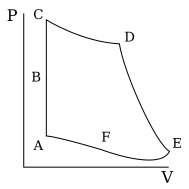
- A: Estates General is called
- B: King Louis is beheaded
- C: Reign of Terror
- D: Directory formed
- E: Coup of 18 Brumaire
- F: Battle of Borodino
- G: Battle of Leipzig
- H: Treaty of Paris
In the northern front of the battle of Leipzig, Blücher's main force, under command of Langeron, squared off against Ney's Polish regiments, under command of Dabrowski, in the twin cities of Wiederitzsch north of Leipzig. But while that was going on the real action was taking place a couple kilometers to the west.
There, von Yorck's Prussian army squared up against Marmont's French army. Marmont's troops were pushed out of Lindenthal, and then Wahren, before digging in in Möckern.
[todo: steps of first battle in Mockern]
Von Yorck pushed Marmont's position several more times, taking heavy damage. In a last ditch effort, von Yorck snuck some hussars and uhlans close to the french infantry and charged.
[todo: steps of this battle. french forming into squares and getting crushed. over and over. Some of them just got flanked. Many guns and prisoners taken. calculations too.]
[todo: Can a heat engine be placed between two nations to generate work?]
To finish the story, 2 days after Marmont's defeat, Blücher was focused the rest of Ney's forces. The fighting was inconclusive until a Saxon unit (?) on the French side defected and turned the tides. Also, Bernadotte and his Swedish army arrived, but mostly just played the positioning game. With Ney's troops defeated, everyone fell back to Leipzig, and started the retreat.
On the fourth and final day of the battle, Bernadotte's troops stormed the city through the Grimmisches Gate.
This last encounter reminds me of a chess match recorded to have been played by Napoleon and Bernadotte, back when Bernadotte was a French Marshal. The game was played, with the emperor as white:
Napoleon Bonaparte v. Jean-Baptiste Bernadotte (later King Charles John), Paris 1808
1.e4 e5 2.Nf3 Nc6 3.d4 Nxd4 4.Nxd4 exd4 5.Bc4 Bc5 6.c3 Qe7 &.O-O Qe5 8.f4 dxc3+ 9.Kh1 cxb2 10.Bxf7+ Kd8 11.fxe5 bxa1=Q 12.Bxg8 Be7 13.Qb3 a5 14.Rf8+ Bxf8 15.Bg5+ Be7 16.Bxe7 Kxe7 17.Qf7+ Kd8 18.Qf8#
[todo: actual game]
[todo: board]
Or maybe that's not correct, because [todo] should be on [todo], but the emperor was a notorious cheater, so who can know?
That same events play out on the board: a stronghold taken after several volleys, and a piercing of the back rank by an idle piece once the rest has fallen. How curious.
Can chess be analyzed in the same way? A two dimensional map of fluctuating temperatures and pressures, with each side trying to perform their preferred thermodynamic transformation.
Forgive my rambling, as you know I've been unwell as of late. I've had little to do these past couple days but write and sleep. The fever causes me to lose track of which ideas belong to the page, and which belong to dream.
This week's Sunday mass read from Romans 8, the part where Paul talks about the Judgement. Romans 8:18-19:
Existimo enim quod non sunt condignae passiones huius temporis ad futuram gloriam quae revelabitur in nobis. Nam expectatio creaturae revelationem filiorum Dei expectat.
Yet what we suffer now is nothing compared to the glory he will reveal to us later. For all creation is waiting eagerly for that future day, when God will reveal who his children really are.
What a fitting epistle, and prophetic too, given that my own fever and misery started up the very next day.
I notice that phrase, "non sunt condignae passiones huius temporis ad futuram gloriam", of course means the same as "non sunt condignae gloriam huius temporis ad futuram passiones". Rearrangement of the words in latin, to some extent, preserve their meaning. The ending -am on the accusative case of the first declension gloria/gloriae cannot be applied to the 3rd declension passio/passionis, and vise versa, locking in their roles in the sentence.
Similarly to an cavalry, consisting of many men moving freely while still possessing a military energy, or similarly to balls on a carom board, all moving but possessing a total unchanging kinetic energy, these words can be arranged in any fashion but still possess the same spiritual energy. The energy imparted on people via God's word, like light shining down on us from heaven, takes the form of independent utterances, discrete corpuscles. Landing with their full energy one at a time, with nothing in-between, just as Newton predicted.
What must the protestants think about this? Were that line read in a protestant church, the energy wouldn't feel the same. We can easily distinguish between "suffering now, glory later" and "glory now, suffering later". Much of the energy is contained in the relationship between nearby words, a sort of potential energy held in the space between words. The same words, the same light, but in the protestant church it arrives at the people as a continuum, like how Huygens predicted.
Corpuscles versus continuum, like the latin versus the vernacular mass, reflects the beliefs of the catholic Issac Newton versus protestant Christaan Huygens, which itself reflects the animosity of the British versus French at Leipzig (as Huygens lived in Paris most his life, and also was Hagenaaran, which had been annexed by Napoleon by then). And like before that, the Magna Carta versus the Declaration of the Rights of Man. It's like this, maybe all the way back to the very beginning, to discrete islands separated by water versus the continuous continent. And now we're back to the start again.
- something about military tactics. Long lines leard to high volume and low pressure.
- something about Marie Carnot, president, & assasination
- the banging of guns, The Model 1777, caused by gas expansion. Both to accelerate and to cause sound.